
 |
This describes "ARMAC" - a home-designed and constructed fire defence system for a house in Victoria Australia. "ARMAC" stands for an Adjustable, Remotely Monitored and Controlled fire defence system.
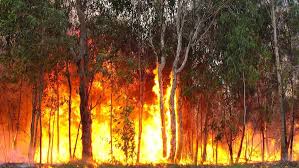
With climate change, Australia (and many other places) are facing the prospect of ever more ferocious "bush fires" ("wild fires "). So how can we protect vulnerable houses? Commercial solutions often rely on providing intense "rain flood" from the roofline down around the house. But how do you know when to switch that on? And what about the fact that most houses burn down because of ember attack perhaps hours prior to the fire front arriving (if it ever does). This system is designed to work differently. Here's how:
- As usual it has a big tank of water (replenished from the mains) and a big diesel pump in a shed. That is connected to a (big) buried polypipe to carry water around the house. Everything above ground is connected in copper pipe.
- Around the house (and on its roof) are sprinklers. Unusually, these are impact sprinklers on stands which advance the direction of their spray automatically through an arc, or even a full circle. This way the system can wet large areas of the house (and surrounds) with very few sprinklers (13) and use less water than a "flood". The pump shed is also cooled with its own watering sprays.
- In the pump shed is a water flow control system. It has a series of valves which can determine the flow rate of water and how often it is sprayed. It can for example, turn the sprays on for 2 minutes, and then off for 5 in an early period of ember attack. This can be achieved either leaving the pump on but diverting the water back to the tank, or turning the pump on and off.
- Matching the mechanical plumbing control system (which uses motorised valves) is an electronic control system which controls the valves.
- It can do this in several ways: remotely over the internet via an app, over the mobile network with sms messages, and autonomously by making its own decisions based on sensor inputs, if communications with the outside world break down.
- There are sensors which provide a reasonable picture of what is going on. Temperature sensors report on temperature inside and outside the shed. Another sensor reports on the water level in the tank. Other sensors report whether the pump is actually on. There is also a home-brewed ember attack detector (still under development), and a video camera mounted outside can be manoeuvred to monitor the outside world.
- Finally the system can be set to send alerts by SMS as conditions change. It also has a simple threat model to indicate likely threats from fires in its zone. Under development also, it is intended to be able to spray fire retardant gel over the house if water runs low.
<< Welcome | | What isn't this? >>