
The water storage and delivery system forms the backbone of ARMAC's capability. Water pressure can drop to close to zero in the time of a bushfire and a self-sufficient water supply is crucial.
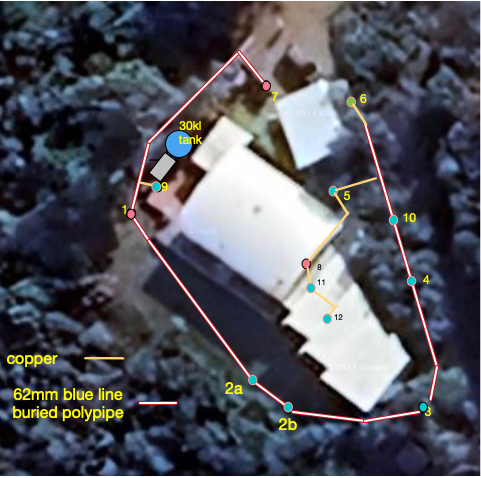
As in the location of this system, there are practical limits on how much water can be stored. For this system, a 30,300-liter Aquaplate tank (3.5 meters diameter, 3.1 meters height) in shale grey Colorbond provides the primary water reserve. The tank sits on a compressed crushed rock base positioned next to a side deck of the house, with automatic replenishment from mains water via a stainless steel floating ball valve rated to 1.0 MPa. At the system's nominal 170 L/min flow rate in reduced-flow mode, this capacity supports 178 minutes (approximately 3 hours) of continuous operation, extending to over 10 hours when operated in intermittent cycles with appropriate on/off timing.
 |  |  |  |  |
(click photos to enlarge them)
Water delivery to the sprinklers is accomplished by a
Garpen WP3DELHPS diesel-powered pump: 11 horsepower electric-start engine with a 3-inch single-impeller high-pressure pump. The manufacturer specifies maximum head of 70 meters (equivalent to 720 kPa pressure) and maximum flow of 630 L/min, though actual performance from bench testing with 2-inch reduced outlets shows approximately 50 meters head at 130 L/min and 45 meters head at 300 L/min. The pump's 13.5-liter diesel tank provides approximately 6.5 hours of runtime at the 2 L/hour consumption rate. The electric start system, controlled by both the SMS-based SFS01-V2 pump control module and direct relay command from the Arduino control system, enables reliable remote activation.
The buried feeder pipe network consists of 100 meters of DN50 (63mm external diameter) high-pressure blue-line polypipe, chosen for its exceptional pressure rating and resistance to heat damage when buried at adequate depth. The pipe was laid in trenches generally 250-350mm deep, well exceeding the 100mm minimum depth recommended by CSIRO research for protection against radiant heat from burning surface fuels. At critical locations where trenches were shallower due to rock or tree roots, earth was backfilled above the pipe to ensure adequate coverage. Saddle clamp fittings at each sprinkler location allow copper risers to tap into the feeder pipe without compromising its pressure integrity.
For more background and technical detail refer to Pump, Tank, Pump system layout.
<< Key Choices: Wetting Technology | | Sprinkler Selection and Placement >> |Table of Contents>