
Architecture
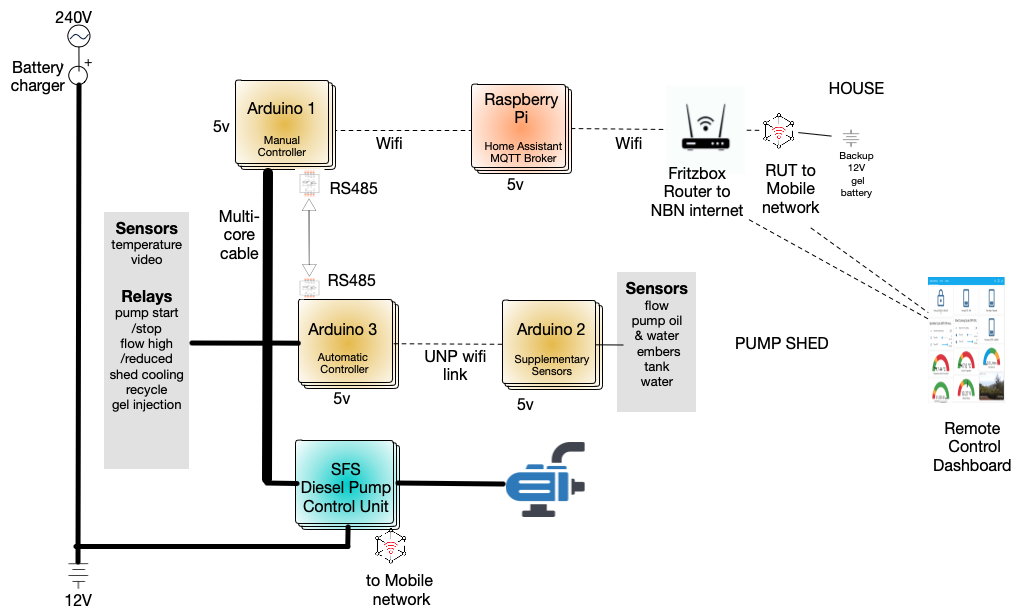 |
In designing this system it became clear that bushfire defence for residential properties presents some complex interacting challenges. The system must operate reliably under extreme environmental conditions, make intelligent decisions in the absence of human oversight, conserve finite water resources while providing adequate protection, and maintain functionality even when primary communication networks fail. ARMAC is a home-developed but sophisticated five-module fire defence system that addresses these challenges through distributed computing architecture, redundant communication pathways, comprehensive sensor fusion, and intelligent autonomous decision-making algorithms. The system relies on engineering principles typically associated with industrial control systems and life-safety applications, adapted to the specific requirements of residential bushfire defence.
The fire defence system is built around three fundamental design principles that inform every aspect of its implementation. First, resilient operation through redundancy ensures that the system remains functional even when individual components or communication links fail. Second, intelligent autonomy allows the system to make appropriate defensive decisions based on real-time sensor data without requiring human intervention during critical moments. Third, distributed computing prevents single points of failure by delegating specific responsibilities to specialized modules that can operate semi-independently while coordinating through multiple communication channels.
The physical implementation consists of five distinct modules, each housed in separate enclosures and connected through a carefully designed network topology.
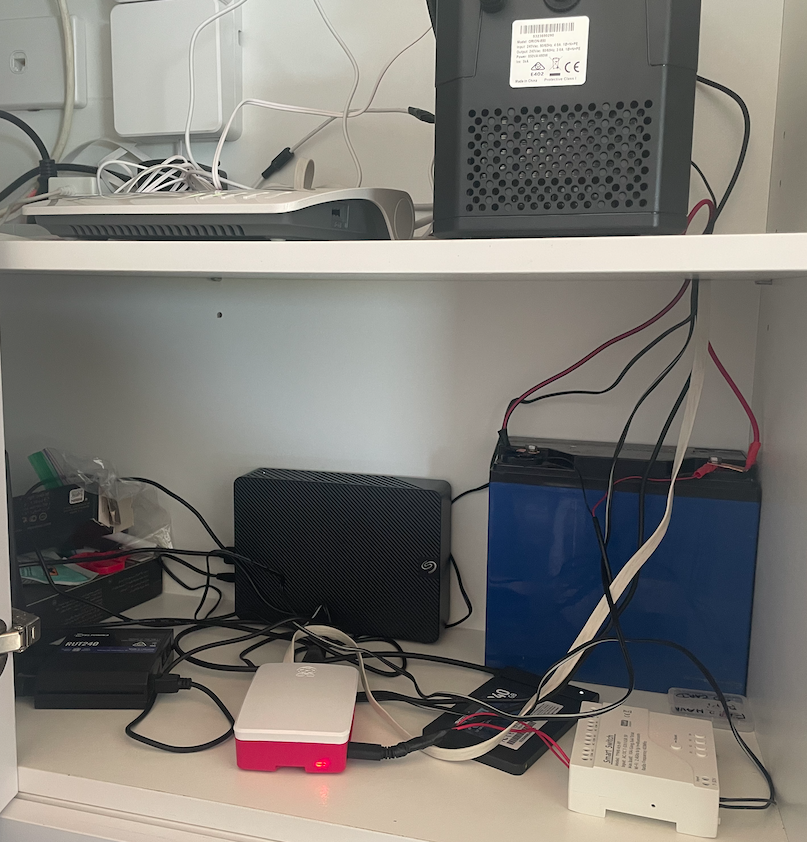 |
Module 1: Coms Module, located in the main residence in direct connection with the NBN cable internet supply, serves as the network and control hub. It contains a Fritzbox router providing primary NBN connectivity, a Teltonika mobile modem for failover internet access, and a Raspberry Pi-4B 4GB micro computer all supported with battery backup. The Raspberry Pi runs containerized services including Tailscale for secure remote access, Home Assistant for the web-based control interface, and Mosquitto as the MQTT message broker. A Tuya network-controllable switch enables remote reset of the Raspberry Pi if required. With these components this module provides the primary human interface to the system and maintains connectivity even during power outages or primary network failures.
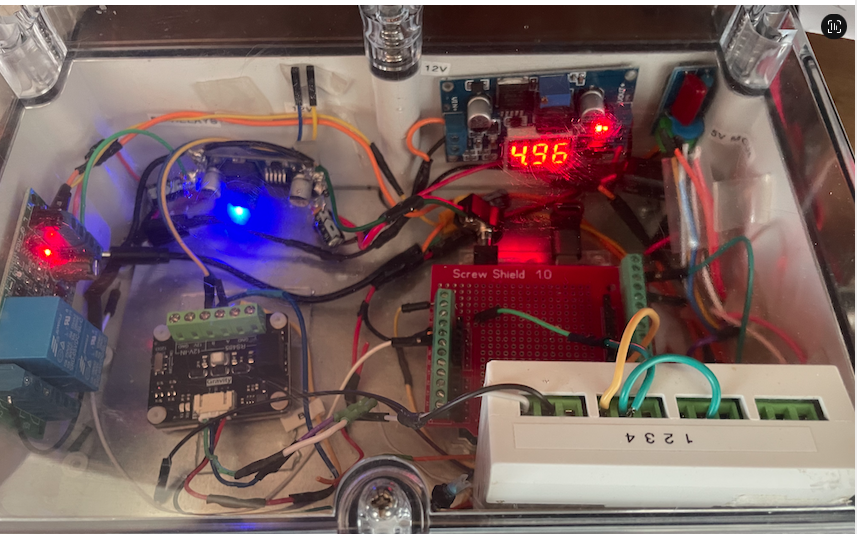 |
Module 2: Remote Control Module, also located in the house, contains Arduino AR1, an UNO R4 WiFi microcontroller that serves as the critical bridge between the home network and the pump shed system. This Arduino communicates with Home Assistant via MQTT and UDP protocols while simultaneously managing RS-485 communication to the shed-based control system over a multicore cable. A second Tuya switch provides remote reset capability for this Arduino, ensuring that the communication bridge can be restored remotely if it becomes unresponsive. The strategic placement of this module in the house, rather than the shed, ensures that the primary control interface remains accessible and that the long-distance communication to the shed is handled by the robust RS-485 protocol rather than less reliable wireless methods.
For more background and technical detail refer to Electronics and Control Systems, House-based Electronics Control Sub-system, Outline of the water control system.
<< Summary: the integrated physical infrastructure | | Electronic Modules >> |Table of Contents>