
 |
Developed over eighteen months of design, procurement, testing, and construction for a coastal property in Victoria, the system is focussed on creating a flexible, long-duration defence capability against both ember attack and fire front passage. The approach taken here diverges significantly from the usual commercially available spray systems using fixed head sprays mounted along the roof gutter line.
What you will find here is a description of the physical architecture of ARMAC, the rationale behind component selection, the hydraulic design considerations, the protective measures for critical equipment, and the integration of all physical elements into a more cohesive defensive system. The total implementation cost of approximately $31,000 AUD represents roughly one-third for some professional assistance in digging a 100 meter trench and foundation work for tank and shed, the rest being my own labour, and thus if not free, at least uncosted. Of the remaining cost, approximately one-third was for basic infrastructure (shed, tank, pump, and control module), and one-third for copper piping, fittings, sprinkler heads, control valves, sensors, electronic components, and necessary tools.
The foundational architectural decision in ARMAC was the adoption of pole mounted impact sprinklers positioned a modest distance from the house surfaces to be wetted, rather than the conventional approach of fixed-head spray nozzles mounted along rooflines and gutters to create a downward 'rain screen'. This choice turned out to be consistent with research by CSIRO fire scientist Justin Leonard, who emphasises the comparative efficiency of perimeter sprinklers that project water back toward structures. As Leonard explains, perimeter systems prove "potentially far more effective because they get it under the eaves, they get it on the wall surfaces, and they deliver water to all those ground and surface fuels," whereas roof-mounted systems struggle to address all aspects of bushfire risk. The Australian Standard AS5414 for bushfire external water spray systems specifies application rates of 10 liters per square meter per minute on windows, 5 L/m²/min on roofs and decks, and 1 L/m²/min on perimeter ground surfaces. Literal compliance would require approximately 2,850 liters per minute for the property in question, exhausting a 30,000-liter tank in merely eleven minutes. Commercial fixed-spray systems typically operate at 300-500 L/min, providing protection for under one hour before water exhaustion.
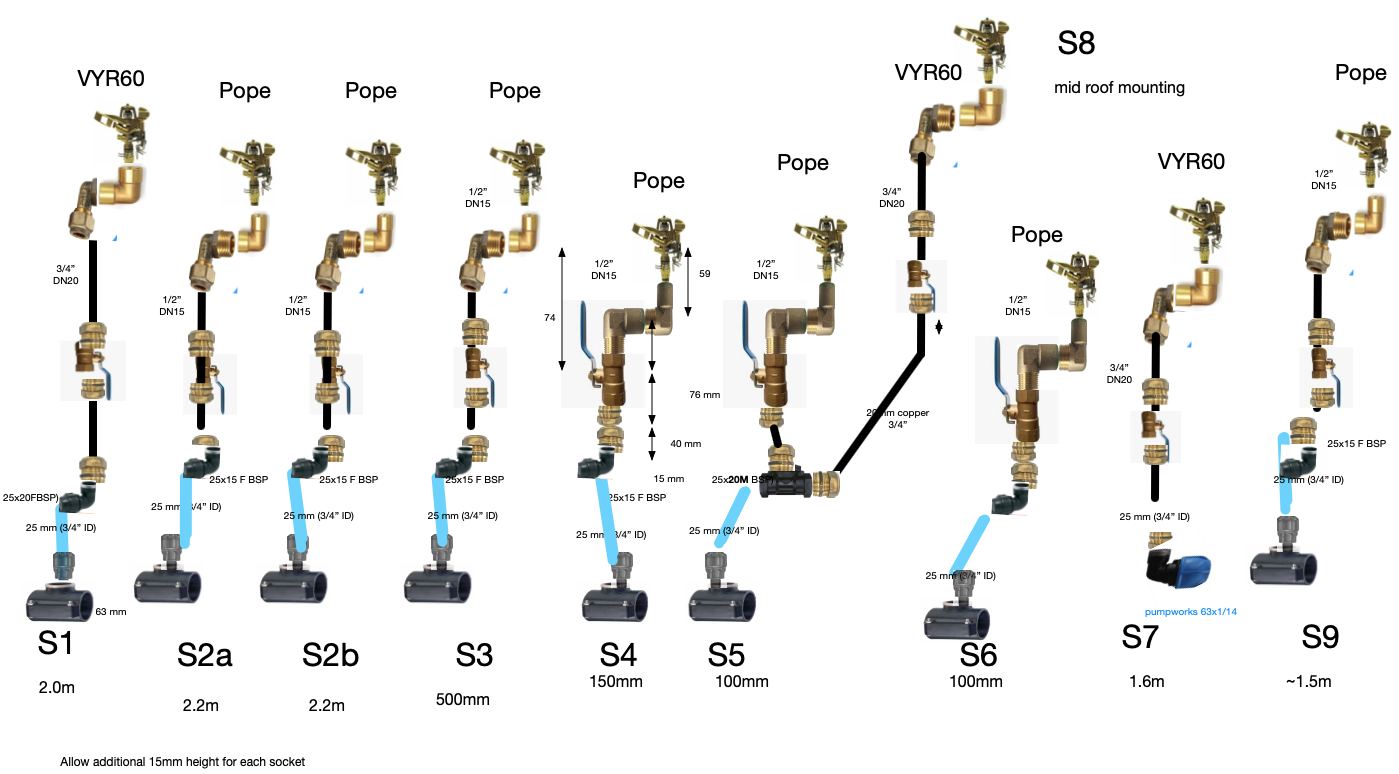
(Sprinkler design (used in planning) - click to see full size graphic)
There is no point in being starry eyed about any of these fire-defence systems whether commercial or home-grown. According to one CSIRO presentation more than 90% of them fail in the face of a full-on fire front. The reason is clear enough - diesel or electric motors, and even steel, brass and copper fittings, all have their temperature limits. It is hard to get water everywhere it is needed. Huge winds can confound water sprays. And there is only so much cooling that is achieved by a water flow, however great. With this thought in mind, this system focuses on what can be reasonably well defended against, and which is the cause of most building destruction. And that is ember attack.
ARMAC's design philosophy recognizes that most houses destroyed in bushfires succumb to ember attack either before or after the fire front passes, rather than during the brief 15-30 minute fire front transit itself. This observation drives the system toward intermittent operation at lower flow rates over extended periods, rather than massive water application during a short window. The standoff impact sprinkler approach allows comprehensive surface wetting including difficult-to-reach areas beneath eaves, while adjustable spray patterns enable precise targeting of vulnerable surfaces. The system operates in five distinct modes ranging from gravity-fed shed cooling (minimal water use) through intermittent low-volume spray (hours of coverage) to continuous high-volume defence (with a delivery time of about 30 min), with each mode appropriate to different threat conditions.
For more background and technical detail refer to Description, Outline of the water control system.
<< Key Choices: Threat Model | | Water Infrastructure >> |Table of Contents>