
To defend the house, water has to be supplied where it is needed. In this design the house and shed are defended against fire and ember attack with with a set of impact sprinklers situated around it in order to provide a wet corridor to the house and to wet all vertical surfaces and decks.1
A DN50 (2” internal diameter) high pressure feeder polypipe (external diameter 63mm) has been laid around the house at a depth exceeding 10 cm (ie a trench depth > 100+50 = 150 mm) which has been shown to be sufficient except in areas where a major fuel load (for example – running under a burning fence or vehicle?2) Dug by a trenching tool, the trench is generally 250-350 mm in depth. In places where that is reduced earth is back-filled on top. Sprinkler heads are serviced by copper risers each equipped with a brass ball valve, running underground to saddle couplings at the feeder polypipe.
The feeder pipe is connected to a colorbond/aquaplate tank via a diesel pump. The tank sits on a horizontal bed of crushed dust situated behind the brush fence on the side deck. A 30,300 l (3.5m diam, 3.1 m high) tank is fed from the water mains regulated with a float valve to ensure it replenishes utilised water. A recirculation circuit allows water to be directed at will from the pump back to an inlet at the top of the tank.
The pump is housed in a metal weatherproof shed, mounted on a concrete pad and protected by water sprays. It is able to be started both manually, by various remotely controlled switches which can turn it on and off, and/ by an autonomous module programmed to respond to various sensors, including to temperatures measured inside and outside the shed. Video and tank water-level monitoring are incorporated, integrated to the home internet via wifi. The control of the system is via an LTE G4 SIM card (for the pump) and, for the other components, via home WiFi so arranged that if connection is lost the connection will failover to another LTE G4 SIM card. The home Fritzbox is powered by a 22AH 12V lead acid battery run through a mains connected inverter, battery charger and surge protection unit.
The system has been compared with local commercially available roof-mounted fixed spray systems and although different in concept appears to offer similar or better protection together with flexible remote control, remote sensor read-outs, adjustable rates of water usage, more targeted wetting of potentially vulnerable surfaces, and the capacity for many hours more of intermittent cinder defence, and capacity for autonomous decision making in the case of communication breakdown with the external world. (For some further discussion of this see Appendix 7) The current arrangement of impact sprinklers is shown below. The system was installed (albeit mostly by means of the owner/designer’s labour) for approximately $31,000.
Of that cost, roughly one third was for some paid assistance to trench and bury the feeder pipe, emplace the posts, construct the shed concrete pad and tank base), one third for basic infrastructure (shed, tank, pump, and pump control module), and the remainder for copper pipes, hoses, brass and stainless steel fittings, sprinkler heads, control valves, sensors, and some needed plumbing and electronics tools, and electronic components.
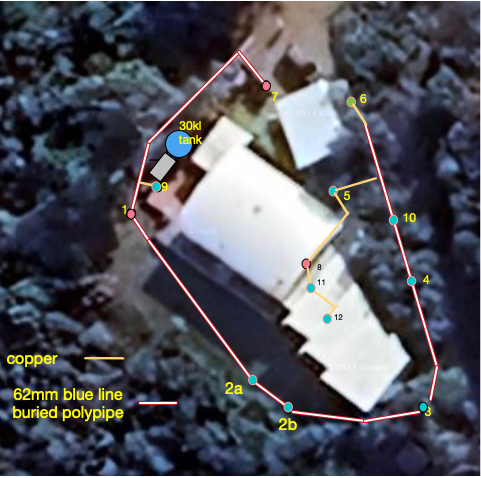
Figure: Buried feeder poly pipe and sprinkler mounts.
For more background and technical detail refer to Development Notes.