
 |
 |
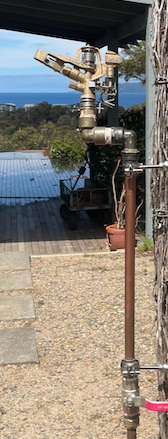
All fittings above ground outside the pump shed are in brass or copper. Each sprinkler is served by a copper pipe riser from the buried feeder pipe, with pipe diameter selected based on the sprinkler's rated flow: 15mm (½-inch) copper for the 10 L/min Pope sprinklers and 20mm (¾-inch) copper for the 20 L/min VYRSA units. Copper was chosen over plastic alternatives for its fire resistance, pressure capability, and long service life, despite higher material costs and more labor-intensive installation requiring flaring tools and compression fittings.
The riser design incorporates adjustability for both vertical and horizontal spray direction. Each riser terminates in a flared compression fitting connected to a brass elbow with male BSP thread. A second brass elbow screwed onto the first allows horizontal rotation for spray direction, with the sprinkler itself threaded onto this second elbow. Vertical angle is adjusted by loosening the compression fitting, rotating the entire elbow assembly, and retightening. This simple mechanical arrangement provides full directional control without complex gimbal mechanisms.
Sprinklers are mounted on treated pine posts of varying heights (ranging from 10 on the uphill side to 230 cm above ground on the downhill side) concreted into position, with copper pipe clamped to the posts using standard copper tube clips. Additional height beyond the post top is achieved by extending with copper pipe as needed. The exposed copper piping, while aesthetically industrial rather than concealed, provides the advantage of easy inspection and repair while maintaining indefinite service life when properly supported.
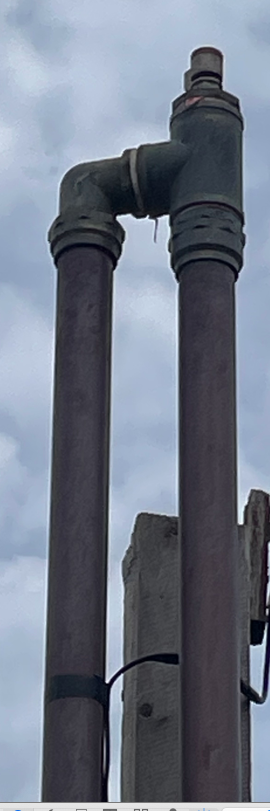
Since multiple sprinklers sit below the water level in the elevated tank, an anti-siphon system prevents water from draining through the pump and sprinkler network when the pump stops. The solution employs a vacuum breaker: a brass tee fitting with an air intake check valve, combined with an elbow, mounted on a dedicated post. This simple atmospheric vacuum breaker ensures that when pump pressure ceases, air enters the system at a high point, preventing siphon action that would otherwise drain the tank through the lowest sprinklers.
Except for a couple of exceptions within the pump shed (which has its own cooling system) any above-ground connections between the sprinklers and pump, etc, is via copper pipes which must be joined. Flared brass compression fittings (no olive) were selected for all external ARMAC copper pipe runs bearing in mind that joints must remain sound during direct fire exposure, not merely during normal operation. Press fittings were rejected on the basis of cost and because they use a nylon seal which is temperature vulnerable (the fire rated version being even more expensive). Soldered copper joints were rejected because lead-free solder softens well below bushfire-relevant temperatures and offers little strength once water flow (which provides cooling) is absent, for example during intermittent system activation. Silver-brazed joints, while thermally robust, are pretty costly due to the silver content. Grooved (Victaulic-style) mechanical couplings were considered for their tolerance of pipe misalignment, particularly relevant on larger-diameter runs, but were excluded because their seal depends on an elastomeric gasket rated well below fire-exposure temperatures.
For more background and technical detail refer to Copper Pipe Risers to Sprinklers, Anti-Syphon Control, Adjustable Sprinkler mounting.
<< Sprinkler Selection and Placement | | The Pump Shed: Protection, Cooling, and Environmental Control >> |Table of Contents>