
 |
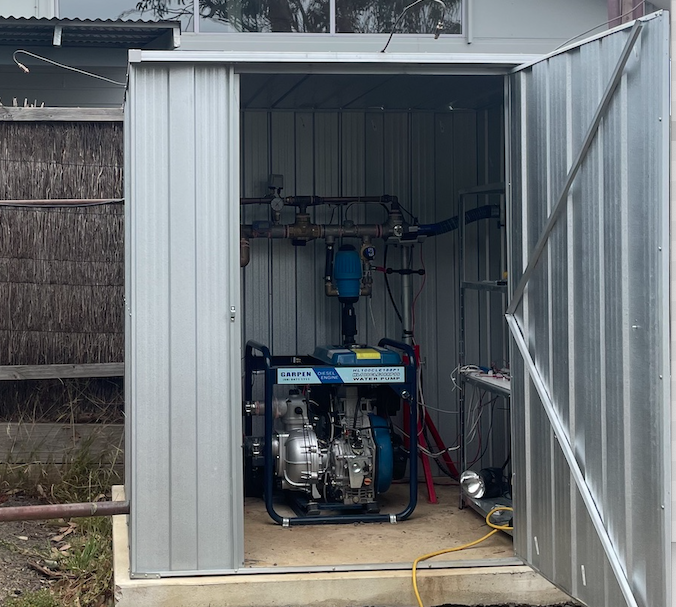
The pump and its control electronics require shelter from weather and fire while maintaining ventilation for diesel engine operation and heat dissipation. A Yardstore F54 ZN flat-roof metal shed (1.76m wide × 1.41m deep × 1.80m high) with single hinged door and 15-year warranty houses the Garpen pump, relay boards, motorized valves, and autonomous control electronics. The shed sits on a concrete pad poured to provide a stable, level surface to which the pump cage is bolted preventing pump vibration from causing fitting looseness or pipe stress.
Shed cooling represents a critical design challenge, as ambient temperatures during severe fire conditions may exceed 50°C, while the pump's own operation generates substantial heat. The cooling system employs five stainless steel flat-fan spray nozzles (1.1mm orifice, ¼-inch BSPT thread) mounted to cover the entire 13.54 square meter surface area of walls and roof. At full pressure, these deliver approximately 5 L/min total flow, providing 0.37 L/m² per minute of cooling water. Assuming 20% evaporation rate, this equates to approximately 2.8 kW/m² of cooling power, or about 9.4 kW/m² at 50% evaporation—adequate for radiation levels in the BAL-12.5 to BAL-19 bushfire attack level classifications.
The shed cooling system operates via a dedicated 2-way motorized valve. In Autonomous mode, AR3 runs a built-in thermostat: cooling pulses activate when internal shed temperature exceeds 47°C (after cooling below 45°C), escalating to continuous operation if pulses occur less than two minutes apart, and switching immediately to continuous above 60°C. In Remote (manual) mode, shed cooling behaviour is set via the TimeON2 and TimeOFF2 dashboard controls: both zero causes P2 to follow the main pump (on when the pump runs, off when it stops); TimeON2 greater than zero with TimeOFF2 zero forces continuous cooling; TimeON2 zero with TimeOFF2 greater than zero keeps cooling off; and both greater than zero runs timed intermittent cycles. Importantly, shed cooling can function even when the main diesel pump is inactive, as it operates on gravity feed from the elevated tank through 12mm copper pipe. This ensures electronics protection remains available throughout the fire event lifecycle.
Ventilation posed a design dilemma: the diesel engine requires substantial air intake (particularly for combustion), yet ventilation openings admit hot external air once ambient temperature exceeds internal shed temperature. The adopted solution relies on passive air ingress through the shed's construction gaps combined with active cooling via water spray, rather than forced ventilation. The pump exhaust exits through a 2-inch stainless steel pipe penetrating the shed wall, coupled to the pump's exhaust port via a 400mm length of 40mm diameter high-temperature silicon hose. Future enhancement options include fire dampers (such as the Lorient LVH44 intumescent fire damper or Kilargo IFD44-L with sodium silicate slats) that automatically close at approximately 100°C, or curtain-type fire dampers with fusible links, though current testing suggests spray cooling alone provides adequate temperature control.
For more background and technical detail refer to Pump Shed, Pump shed protection, Pump shed ventilation, Consideration of further insulation.
<< Copper Risers, Adjustable Mounting, and Anti-Siphon Protection | | The Water Control System: Valves, Sensors, and Flow Management >> |Table of Contents>