
 |
Comprehensive sensor coverage provides the data foundation for both remote monitoring and autonomous decision-making. The sensor suite incorporates multiple measurement principles and technologies selected for reliability under fire conditions.
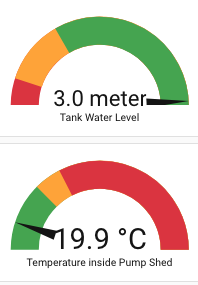
Water Level Monitoring - A Connectivity 5V DC analog depth sensor mounted at the tank bottom outputs 0-3.3V DC proportional to water column height, with 3.3V corresponding to 3.2 meters depth. The sensor sits in a protective housing at the tank's lowest point, ensuring accurate measurement throughout the usable water range. The signal cable runs in high-temperature silicone sleeve along the recirculation pipe path to the pump shed, where Arduino AR2 samples the analog voltage via its A0 input. Simple linear conversion calculates depth: depth_m = (voltage / 3.3) × 3.2. At lower water levels, if the sensor cable is destroyed by radiant heat, the system transitions to calculated water level based on measured flow consumption since the last valid reading.
Temperature Sensing - Three DS18B20 digital temperature sensors on a common 1-Wire bus provide critical thermal data. These devices communicate via the Dallas 1-Wire protocol, each identified by its unique 64-bit address burned into the chip during manufacture. The sensors are address-locked in software to specific functions: T1 (address 28-5B-83-57-00-00-00-13) monitors external ambient temperature, T2 (address 28-2E-53-57-00-00-00-3E) measures internal shed temperature, and T3 (address 28-11-F1-35-00-00-00-D0) tracks a hybrid measurement with its metal tip protruding through the shed wall. Operating at 12-bit resolution (0.0625°C precision) with a 5V supply and 2.4kΩ termination resistance, these sensors provide temperature data every 750ms. The system includes resilience logic: if all three sensors return invalid readings for five consecutive samples, automatic bus re-initialization attempts recovery from transient electrical noise or brief disconnections.
Flow Measurement - Dual Hall-effect turbine flow sensors are intended to monitor water movement at critical points. A DN15 sensor on the mains water inlet to the tank (approximately 450 pulses per liter) tracks tank replenishment, while a DN50 sensor on the pump output line measures sprinkler flow (approximately 60 pulses per liter, requiring field calibration). Both sensors will connect to Arduino AR2's interrupt-capable pins (pins 2 and 3), with interrupt service routines counting pulses and implementing 8ms debouncing to eliminate false counts from mechanical vibration or electrical noise. Every 100ms, the main program reads accumulated counts, clears the counters, and calculates flow in L/min: flow_Lpm = (pulses × 10 × 60) / K_ppl where K_ppl is the sensor's pulses-per-liter constant. A visual flow meter and pressure gauge mounted in the control pipe provide manual verification of system performance during testing and maintenance.
For more background and technical detail refer to Sensors, System response to Ember attack.
<< Water Control System cont | | Sensor Integration cont >> |Table of Contents>