
 |
Battery Monitoring - A resistor divider network scales the 12V battery voltage down to Arduino-compatible levels at analog pin A2. The divider ratio was calibrated empirically: at 12.0V battery voltage, the ADC measured 2.53V, yielding a conversion factor of 12.0/2.53 = 4.743, with an additional system correction factor of 0.55846 accounting for voltage drop in wiring between battery and sensing point. Raw ADC values convert to battery voltage via: V_battery = V_adc × 4.743 × 0.55846. Because battery voltage fluctuates significantly during pump cranking (potentially 200+ ampere draw), an exponential moving average filter with 45-second time constant smooths the measurements, tracking genuine state-of-charge changes while rejecting transient load variations.
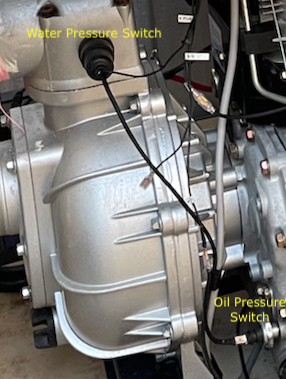
Pump Health Monitoring - Two pressure sensors provide real-time pump status. An oil pressure switch (normally open, closes when oil pressure builds) connects through a PC817 optocoupler to digital pin 10 on AR2, with the optocoupler providing electrical isolation between the pump controller circuits and the Arduino. LOW signal indicates oil pressure present (engine running); HIGH indicates oil pressure absent (engine stopped or failed). A water pressure sensor taps the pump controller's internal pressure transducer test point at analog pin A1, reading approximately 0V when the pump builds hydraulic pressure, rising to 1-3V when idle or hydraulically failed. These dual measurements distinguish mechanical failure (oil pressure OK but no water pressure indicating pump or valve problems) from engine failure (no oil pressure). (For detail how the water and oil pressure switches are fitted and in particular how the pump casing was drilled and tapped for the water pressure switch see pump sensor fitting details).
Ember Detection Two approaches have been followed:
- A simple ember detection was built employing an infrared flame sensor module (760-1100nm wavelength sensitivity, 80cm detection distance) mounted within a weather-protected housing. The sensor connects to AR2's analog input, with detection logic requiring sustained flame signature of at least 2ms to eliminate spurious triggers from reflections or transient light sources. The problem with this approach is the uncertain sensitivity of the detector in situations of changing light, temperature, and wind.
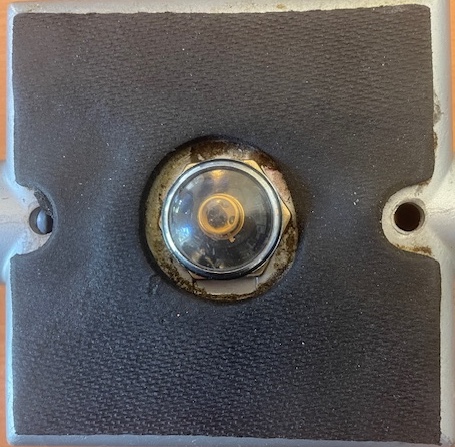 |
- More recently another approach has begun which is more complex, but more likely to work reliably. This utilises an industrial Pyrotector Model 30-2054A made by Detector Electronics Corporation. This is designed to detect over a broad range with, for example, 0.6 cm diameter embers in flues in industrial contexts detected at up to 2.2 meter for those moving at 12 cm/sec (0.4 km/hr), or up to 7.6 meter for those moving at 480 meter/sec (17 km/hr). The device operates at 24 V and this is easily achieved with a step up DC power module from the 12V supply in the shed. The unit purchased ($50 US) is quite old but refurbished and works well at test. The unit requires to work in light at less than 100 lux so it is planned to install it in an aluminium box with a omnidirectional wind catcher directing wind down a 4 cm diameter tube, suitably bent to obstruct light, with embers down into the box, and then out through another similarly bent tube. More details when it is constructed, installed, and tested.
NB - For more detail on the electronic connections of the sensors and their data processing see later; For more on the physical arrangements for the Wind Catcher designed for this particular setup see ARMAC Wind Catcher Specifications
For more background and technical detail refer to Sensors, Tank Water Level Sensor installation.
<< Sensor Integration: Measuring System State and Environmental Conditions | | Pipe Materials, Connections, and Fire Resistance >> |Table of Contents>