
Battery, Charging, and Power Distribution
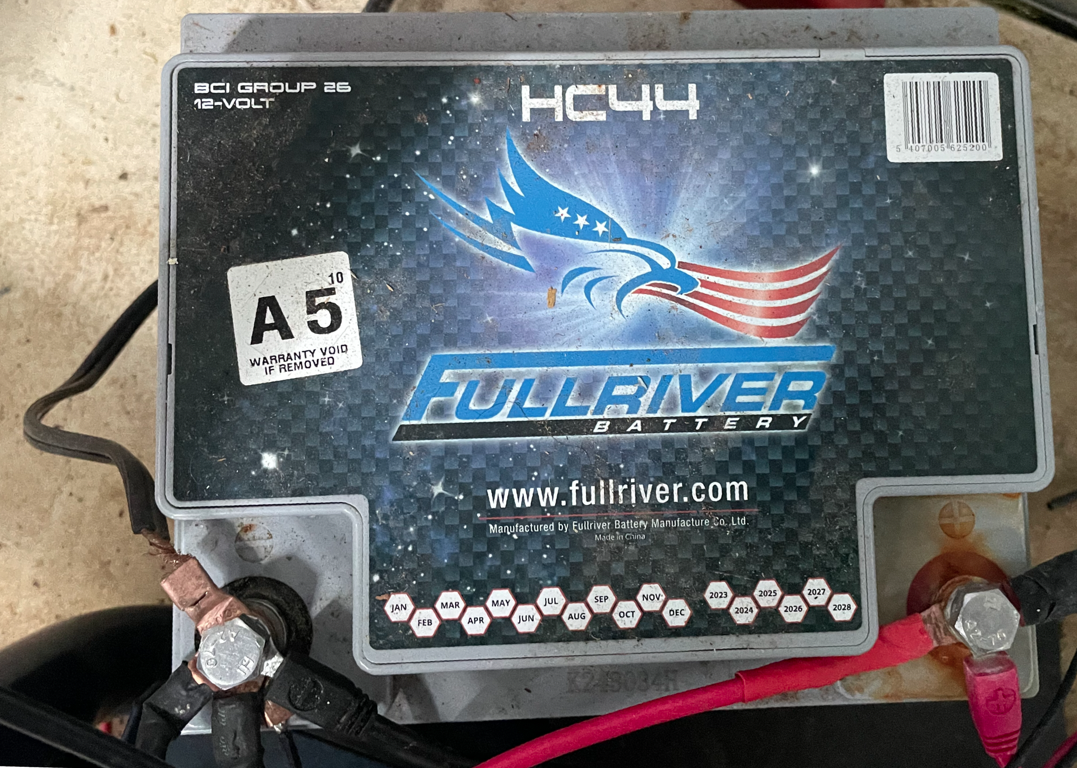 |
The system's electrical power architecture centers on a Fullriver HC44 heavy-duty 12V 44Ah battery providing 560 cold cranking amps, adequate for the Garpen pump's electric starter (requiring approximately 200-400 amperes for 2-4 seconds during cranking). The battery supports not only pump starting but also the motorized valve actuators (drawing approximately 0.8-1.2A each during the 5-15 second actuation period), relay coils, and all electronic control systems.
Battery charging employs a Victron Blue Smart IP65 10-ampere charger located in the house, connected to the shed battery via a two core robust copper underground power cable. The Victron charger implements sophisticated multi-stage charging (bulk, absorption, float phases) with temperature compensation, preventing overcharging that would shorten battery life while ensuring full charge capacity is maintained. During normal standby conditions, the charger maintains the battery in float mode at approximately 13.5V, ready for immediate high-current delivery. Charging performance history is available via a bluetooth connected app.
The conservative planning assumption limits pump restarts to 60-120 cycles per battery charge, though theoretical capacity based on the battery's 560 CCA rating and actual cranking current suggests perhaps 330 cranking attempts before voltage drops below reliable starting threshold. This conservative margin recognizes that battery capacity degrades with age, cold weather reduces available capacity, and voltage sag during high-current discharge may trigger low-voltage cutoffs before the battery is truly exhausted.
Battery voltage monitoring serves a critical role in operational mode selection. The measured voltage (after exponential filtering) determines whether intermittent sprinkler cycles should be implemented via pump start/stop cycling or via continuous pump operation with recirculation valve switching. The threshold is set at 12.25V: above this voltage, the system may cycle the pump if intermittent timing parameters permit (both on-time and off-time exceed 10 minutes), conserving diesel fuel at the cost of some battery power for each restart. Below 12.25V, the system automatically switches to continuous pump operation with RV3 valve cycling between sprinkler delivery and tank recirculation, conserving battery power at the cost of continuous diesel consumption.
Power distribution from the battery employs two separate rails: a power rail for pumps, valves, and other high-current loads, and a logic rail for Arduino and sensor supplies. LM2596 DC-DC buck converters step the 12V battery voltage down to regulated 5V for logic circuits, with separate buck converters for relay coil power and for Arduino/sensor power to prevent cross-coupling of electrical noise from relay switching into sensitive analog measurements. Each buck converter output incorporates 470µF electrolytic capacitors paralleled with 0.1µF ceramic capacitors for low-impedance across a broad frequency range, plus ferrite beads on output lines to suppress conducted EMI.
For more background and technical detail refer to Battery, Battery Cable, Voltage surge circuit protection.
<< The Gel Injection System | | Environmental Hardening and Protective Measures >> |Table of Contents>