
 |
An approach to low water availability is to inject fire-retardant gel into the water stream prior to the tank becoming empty. This approach is still under development. It is designed to allow ARMAC to inject Barricade fire retardant gel into the water stream, creating a protective coating that adheres to surfaces and provides continued fire resistance even after water evaporates. The gel injection system represents one of ARMAC's more sophisticated subsystems, employing hydraulic and chemical engineering principles to achieve precise dosing under varying pressure conditions.
The water supply level is measured directly when the tank sensor is working, but if in the face of a firefront the cable to the tank water level sensor is destroyed, the water level is calculated on the basis of the measured total flow of water out of the tank since the last direct level reading
Current design (boosterless): The gel dosing design will now use the pressure drop across the existing manual Flow reduction tap to drive the gel dosing pump.
See the DevNotes pages for the current design:
The background and design evolution below describes the initial exploration that led to the current design.
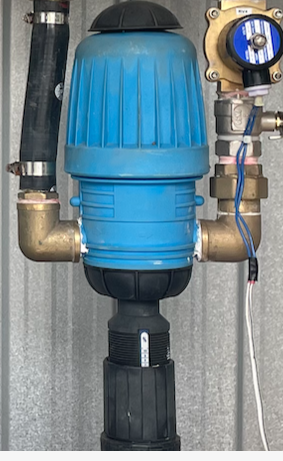
Dosatron for precise concentrations: The foundation component is a Huiji DN009 Dosatron proportional dosing pump, a hydraulically-driven device that uses water flow as its power source to inject a secondary liquid at a preset concentration ratio. The Dosatron operates across 0.2-6 bar pressure differential (inlet pressure above system ambient) and accommodates flow rates of 50-2500 L/hour (0.8-42 L/min). Crucially, the Dosatron maintains its set injection ratio across varying flow rates and pressures, unlike venturi injectors which exhibit pressure-dependent performance. The inlet and outlet diameters are 25mm (internal) and 32 mm (external) and the internal flow is straight through at 25mm. (NB plumbing fittings are labelled by their internal bore diameter, so the unit requires 25mm fittings). The unit was purchased on Alibaba.com for $US 95.
Initial two-branch approach with electric booster pump (superseded): The initial architecture explored a two-branch approach to overcome the back-pressure challenge: the Dosatron requires positive inlet pressure (0.2-6 bar above system pressure), but the system's nominal 4.5 bar operating pressure during sprinkler operation left insufficient differential for direct connection. The solution considered was to divert a controlled portion of flow through a Bringsmart JT-1000A3-24 DC 12V inline booster pump before the Dosatron. The Bringsmart pump (1800-2600 L/hour, 4.2-6m head, 0.42-0.6 bar, 3.0A at 12V with dialable speed control) provided adequate boost, but required a powered component and had performance uncertainty at high inlet pressures. The final design avoids this entirely -- see Gel Dosing Overview.
Fail safe design: The system has a normally closed solenoid valve on the Dosatron branch, and a check valve asserting one-way flow on the outlet side. Thus if the Dosatron itself fails, no water pressure is lost in the main sprinkler system. Since the Dosatron is made of polymer, these safeguards prevent any failure from affecting the main sprinklers.
Current dosing target: 1.4% gel concentration, achieved with the Dosatron dial at ~5% and branch flow at ~2000 L/H, driven by the ~3.6 bar pressure drop across the existing manual throttle tap. No booster pump relay is required. The experience of Matt Wegener who supplied the Barricade Gel is that the percent concentration of this Gel in water after mixing should be no greater than 2%, probably around 1%, and it would be sensible to first trial it with a intended percent of about 0.6%. These experiments have yet to be carried out but the design allows the concentration to be dialled in.
The gel reservoir is a 15.2-liter supply of Barricade gel (four 3.8L containers) intended to coat approximately 400 square meters at 2% concentration. The gel is to be consolidated into a sealed container with an agitator mechanism (a 24V electric paint mixer with 10cm impeller) to maintain gel suspension, as Barricade requires periodic stirring to prevent component separation.
Control sequencing for gel injection: When water level falls below 0.30 meters but remains above 0.05 meters (the gel priority band), or when explicitly commanded in emergency conditions, the control system energizes the gel solenoid valve. Flow begins through the Dosatron branch (driven by the tap pressure drop), with the Dosatron drawing gel from the reservoir at the dial-set ratio. The combined stream at say ~1.4% (but selected as desired) dilution proceeds to the sprinklers. Gel application continues until the water level falls below the 0.05m dry cutoff threshold or the gel reservoir empties.
Safety interlocks: If flow drops unexpectedly (detected by the main flow sensor), indicating Dosatron or solenoid failure, the system closes the solenoid, allowing continued water-only sprinkler operation. The Dosatron's 40 deg C maximum operating temperature is mitigated by shed cooling and by gel deployment occurring only during final water exhaustion when fire conditions are likely moderating.
For alternatives that were considered but not adopted, see
- Alternative Approaches and
- Early (superseded) considerations for the Fire Retardant Gel Injection Design
For more background and technical detail refer to Electronically controlled Valves, Water system components.
<< Pipe Materials, Connections, and Fire Resistance | | Battery, Charging, and Power Distribution >> |Table of Contents>