
The Autonomous mode as it was originally designed. Much of it survives, but some of the triggers and figures changed as the code developed and was tested; the present logic is described in Autonomous Fire Defence Algorithms, and every current threshold is in Key data.
Response to ember attack, as first designed
Note (November 2026): in the system as built, ember detection raises an alert only; it does not start a wetting cycle, in any mode.
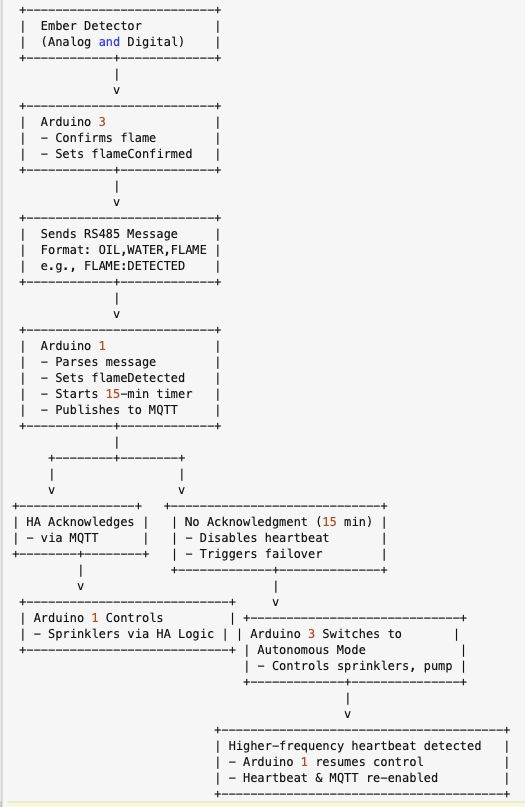
The trigger for initial action is detection of wind-born firebrands – variously referred to as cinders or ember attack. An ember attack sensor has been designed and deployed and as soon as it is activated it sends a message to Arduino 3. Arduino 3 immediately does two things:
- It begins a wetting cycle by turning the pump on on an initial reduced flow, 3 min on and 20 min off cycle.
- It communicates with Arduino 1 which initiates a series of alarm messages to the Home Assistant app. Even if the app is asleep it will be woken and trigger visual and audible alarms on each platform (ipad, iphone or computer) on which it is running. The alarms will be repeated at 5 min intervals until acknowledged from the Home Assistant dashboard or the Autonomous module has established that contact has been lost between it and the internet.
Assuming the Home Assistant dashboard is functional the system can then be manually managed it using the available sensors and video cam to select appropriate responses from anywhere in the world. In the event of communication not being made and no response from the dashboard over the next 5 min (the heartbeat limit), the system will enter Autonomous mode control. However, Autonomous mode can always be switched back to the Dashboard from it.
A flow chart summarising major actions following ember attack detections is shown below:
Criteria for automatic actions, as first designed
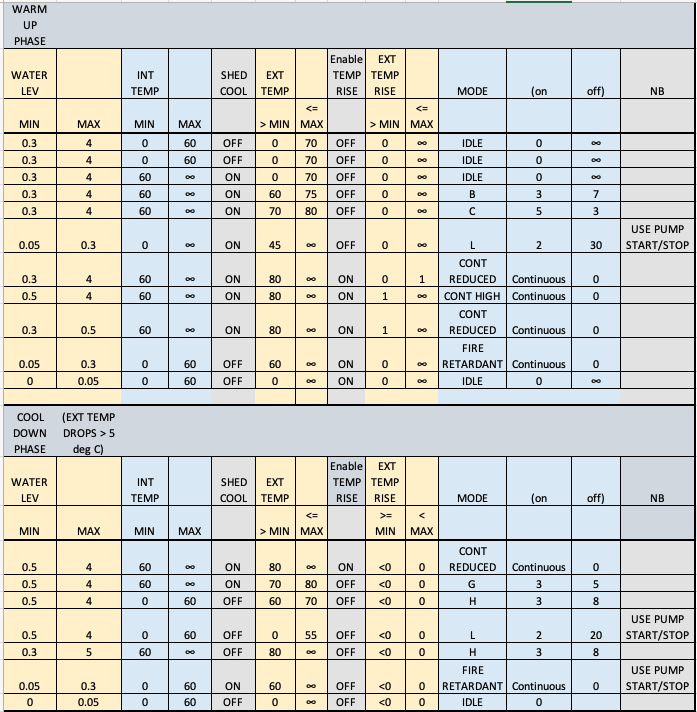
Note (November 2026): the values programmed in AR3 differ - for example sprinkling starts at 60 °C (3 min on, 7 off), high flow is used above 80 °C without a rate-of-rise test, and the battery threshold is 12.0 V with pump cycling only for pauses over 15 minutes.
Even if all of the communication – mobile net and wifi – power off, if the mains power goes down, and the water mains turn off, Autonomous module provides the system with a mind of its own and its own resources. A powerful HC44 battery supplies power, water is in the tank, and a third Arduino micro computer in the shed monitors the engine oil pressure, pump water pressure, and other sensors. It is programmed to do the following (the parameters can be changed to suit): If communication is lost to wifi and the mobile net and to the house control system, and the pump is not going (as determined by oil pressure low, water pressure low, flow zero) then the system will proceed to follow a detailed set of protocols depending on the internal temperature of the pump shed (>60 deg swtiches shed cooling on) and external temperature (>70 deg switches the pump on at reduced flow and running the sprinklers intermittently (3min on, 7 min off). As temperature rises the sprinkling becomes more frequent and once the external temperature reaches 80 deg C, if the rise rate exceeds 3 deg per minute the flow is increased to high flow. Once the external temperature starts to decline the system goes back to reduced flow, then intermittent, and finally stops. The system also monitors the water level, changing its rates of water application depending on the amount of remaining water. If the water level gets very low then the system sprays fire-retardant gel before stopping the pump. Finally battery voltage is monitored and while it is good (>12.5 volt) for the longer intermittent cycles it achieves those by turning the pump off and back on, but if the voltage reduces further, the battery is conserved by leaving the pump on and turning the flow on, or alternative through a recycling valve back to the tank The specific criteria applied in the warm-up and cool-down phases, and actions taken are shown in the following table.
 |
Note the following
- System checks oil and water pressure low before turning pump on.
- Whilst the battery voltage is > a fixed threshold, currently12.25 V, and provided pump is on for at least 5 min in each intermittent cycle, the sprinkler system will operate in intermittent mode by starting and restarting the pump with the starter motor. Once the battery voltage ≤ 12.25 V or the period on is less than 5 min, the pump will stay on and a valve will switch the flow of water to the sprinklers, and then to recirculate to the tank, for each on/off intermittent cycle. For the long intermittent cycle (2 min on, 30 min off) the pump will turn on and off as required irrespective of remaining battery voltage.
- Shed cooling is also run in intermittent mode but as follows. If the pump is off, shed cooling will occur at low flow, fed simply by gravity driven by the difference between height of water in the tank and top of the shed. Once the pump starts the shed cooling will follow the cycle of the pump until the voltage threshold is reached, and thereafter will switch on and off in synchrony with the sprinkler system.
- The end point of cooldown after the fire has passed is “Mode L” which handles any further ember attack by continuing to cycle either the pump on/off or recirculation valve (depending on battery state) with 2 min spraying followed by a 20 min pause. This continues until either (1) the pump runs out of fuel, or (2) water is exhausted as demonstrated by there being flow of < 1 l/min (or flow meter failure) AND low water pressure at the pump as detected by the pump pressure switch. If these two conditions are met, the pump is turned off.
The fallbacks
The temperature-sensor fallback was first programmed in the August 2025 version of AR3, but was lost when AR3's decision logic was rewritten later that year. The tank-level fallback in the August 2025 version kept track of water by time spent in each mode and average flows. Both were restored, in improved form, on 1 November 2026.
<< Development history: the electronics | | Development history: the 2026 refinements >> |Table of Contents>