
The heart of ARMAC's operational flexibility lies in the pump shed's water control system - a set of copper pipes, motorised valves, sensors and manual controls that provides five distinct modes of operation. The relays that drive the valves are listed in Modules and relays.
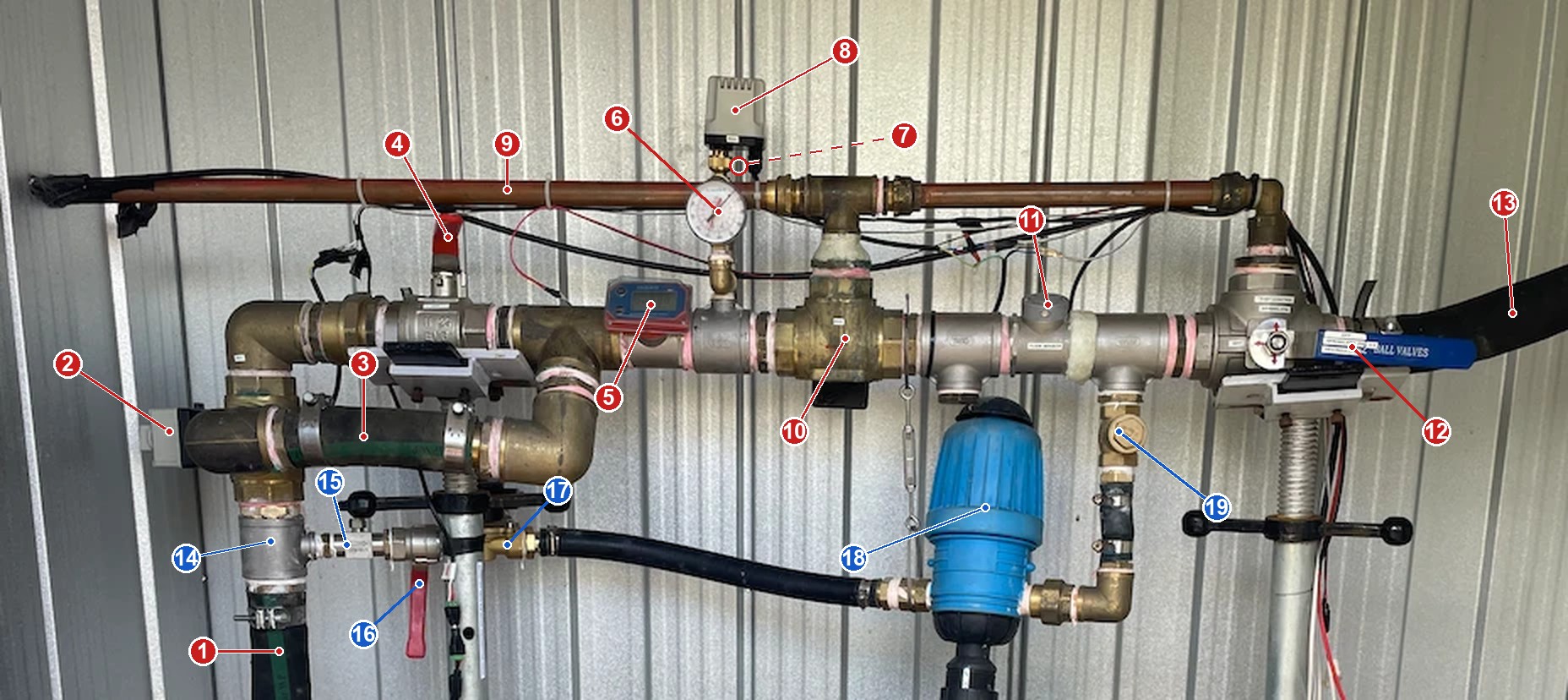
| Main header (red) | Function |
|---|---|
| 1 | Water in from the pump (DN50 fire hose) |
| 2 | RV1: 3-way motorised flow valve (reduced / high flow) |
| 3 | High-flow loop (DN50 bypass) |
| 4 | Preset ball valve on the reduced-flow branch (sets the 147 L/min reduced flow) |
| 5 | Visual flow meter |
| 6 | Pressure gauge |
| 7 | Manual ball valve for the shed cooling sprays (hidden behind the pressure gauge) |
| 8 | RV2: 2-way motorised shed-cooling valve |
| 9 | 20 mm return pipe to the tank |
| 10 | RV3: 3-way motorised recirculation valve |
| 11 | Online flow meter (reports to Home Assistant) |
| 12 | 3-way manual test valve (to the tank or to the sprinklers) |
| 13 | Out to the sprinkler feeder pipe |
| Dosatron gel loop (blue) | Function |
|---|---|
| 14 | High-pressure tap-off, upstream of RV1 |
| 15 | Needle valve: regulates the loop's pressure |
| 16 | Manual ball valve: isolates the loop when required |
| 17 | RV4: solenoid valve, for remote control |
| 18 | Dosatron gel injector |
| 19 | Check valve: if the Dosatron fails from heat while idle, water still flows on to the sprinklers |
The control pipe
Water enters under pressure from the pump through a DN50 (2-inch) fire-rated reinforced hose, rising on the left into a horizontal DN50 copper control pipe that forms the main distribution header, and leaves on the right for the sprinkler feeder pipe. Above it runs a 20 mm return pipe which, through a 3-way manual valve on the far right, can send water back to the tank - either as a test loop, or during the off phase of an intermittent cycle.
From left to right along the header:
- the flow valve: water either passes through a branch containing a preset ball valve, which sets the reduced flow, or in its entirety as full flow through the loop below;
- a visual flow meter and a pressure gauge, set into the main pipe;
- a tee branch diverting a modest flow through a manual valve and then a motorised 2-way valve to the shed's external cooling sprays;
- the Dosatron gel injection loop (see The Gel Injection System), which takes water at full pump pressure from below the flow valve into the Dosatron's intake on the left, and returns it from the Dosatron's outlet on the right, through a check valve, to the reduced-pressure part of the header; on the left side a needle valve regulates its pressure, a manual ball valve isolates it and a solenoid valve gives remote control. The wired online flow meter is above it;
- the recirculation valve and the return to the tank;
- the 3-way manual test valve before the outlet to the sprinklers.
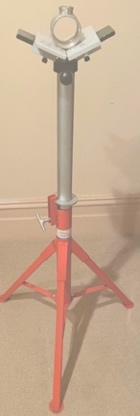
The pipework is supported on two adjustable steel pipe-welder's stands (second-hand from Gumtree for $80), which also made the testing and construction phases much easier.
Four motorised valves
The flow control system uses four remotely operated valves:
RV1 (high/reduced flow) - a 3-way motorised brass valve, normally in the A-B position for reduced flow. In this position water is forced through a DN20 branch containing a preset ball valve that restricts the flow to the minimum needed to run the sprinklers: 147 L/min (measured against the house water meter). When high flow is commanded, the valve switches to A-C, directing water through a DN50 bypass loop that allows 217 L/min. This gives rapid mode switching without any need for pump speed control or pressure regulation. The constriction also creates the pressure difference that drives the gel dosing pump, which is why gel only works on reduced flow.
RV2 (shed cooling) - a 2-way motorised valve, normally closed, which when energised opens to send a controlled portion of the flow, through a manual ball valve and 12 mm copper pipe, to the five shed cooling spray nozzles.
RV3 (intermittent cycle recirculation) - a 3-way motorised valve, normally in the A-B position, sending water to the sprinklers. When switched to A-C it diverts the flow through the DN20 recirculation pipe back to the tank via an inlet at the tank top. Cycling this valve while the pump runs continuously gives intermittent spraying without the battery drain of repeatedly starting the diesel engine.
RV4 (fire retardant gel injection) - a normally closed solenoid on/off valve opening the gel injection branch. A check valve on the Dosatron's outlet side means that if the Dosatron fails (for example from heat) while not operating, water still flows through to the sprinklers. The gel system is built, but not yet tested (see The Gel Injection System).
All the remotely operated valves run on 12 V DC from the shed battery, and are switched by Songle SRD-05VDC-SL-C relays receiving 5 V logic signals from Arduino AR3. Each motorised valve has three control wires - yellow neutral, brown and blue - and a single relay switches it between its two positions: with the relay off the valve drives to (and stays in) its A-B position, water straight through; with the relay on it drives to A-C, through the tail of the tee. The valves are available for about $218 on AliExpress (Acarps Hardware Store) and are described in Appendix 11. They draw about 6 W while the motor runs (for about 5-15 seconds), but stay locked in either position with no power at all - in this sense superior to solenoid valves - and are rated to 95 °C. The 2-way valve used for shed cooling works the same way, with the tail of its tee closed off so that flow is simply on or off.
The default (unpowered) positions are chosen so that the system fails predictably and safely: the flow valve sits at reduced flow, shed cooling is off (conserving water), the recirculation valve delivers to the sprinklers, and no gel is injected.
Three manual valves. There are also three manual valves in the shed: the three-way ball valve before the outlet, which either sends water back to the tank for testing or on to the sprinklers; a two-way ball valve that turns the shed sprays on and off (also mainly for testing) and sets their flow; and the ball valve on the reduced-flow branch, which sets the reduced flow rate. Outside, each sprinkler has its own ball valve to regulate its flow, and a ball valve between the tank and the pump shed allows the tank to be isolated.
Five modes of operation
- Shed cooling only - the shed sprays alone, fed by gravity from the tank if the pump is not running.
- High volume - continuous high flow for when the fire front is close or has arrived (in Autonomous mode, above 80 °C outside); about two hours from a full tank.
- Low volume - continuous reduced flow, for ember attack; just over three hours from a full tank.
- Intermittent low volume - the sprinklers cycle on and off, either by the recirculation valve switching between the sprinklers and the tank, or by starting and stopping the pump itself; ten hours or more from a full tank.
- Low volume with gel injection - on command, or as the water nears exhaustion, a coating of Barricade gel is applied to the house.
A pressure gauge and visual flow meter allow manual observation of the flow, and the online flow meter reports it when the system is under remote control.
Intermittent spraying
Intermittent spraying can be made in one of two ways:
- Valve switching: the recirculation valve switches between sending water to the sprinklers and recirculating it to the tank, while the pump keeps running. This conserves water while maintaining pump operation, and spares the battery and the starter motor.
- Pump cycling: the pump itself is started and stopped. This saves fuel during long pauses, but places more stress on the starter and the battery.
Which is used depends on the battery and the cycle. In manual operation pump cycling is allowed only above 12.25 V and with both on and off times longer than 10 minutes; in Autonomous mode only above 12.0 V and for pauses longer than 15 minutes (see Output Control and Safety Interlocks and Autonomous Fire Defence Algorithms). Run time can be extended further by lengthening the pause, by using valve switching rather than pump cycling, by turning off some sprinklers with their ball valves, and by adding gel at the final stage.
The pump shed
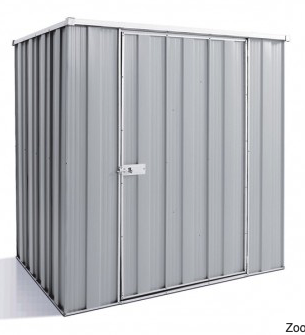
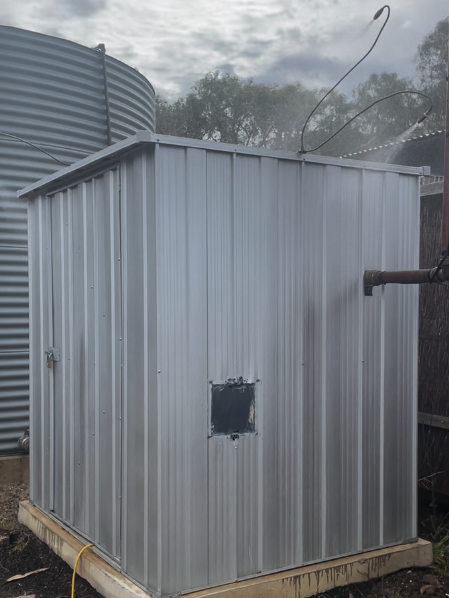
The pump, its controllers and its valves are housed in a Yardstore F54 ZN flat-roof steel shed (1.76 m wide × 1.41 m deep × 1.80 m high) with a single hinged door and a 15-year warranty. It stands on a concrete pad, to which the pump cage is bolted so that vibration cannot loosen fittings or stress the pipes. The Garpen pump itself is about 0.75 m high, 0.66 m deep and 0.55 m wide. Modules 3, 4 and 5 sit on shelves along the right-hand wall.
Shed cooling. Keeping the pump shed cool with sprayed-on water is likely to be important as a fire front approaches, since ambient temperatures may exceed 50 °C while the pump adds heat of its own. Five stainless steel (304) flat-fan spray nozzles with 1.1 mm orifices and 1/4" BSPT threads (seven were bought on AliExpress for $48) spray about 5 L/min over the whole 13.54 m² of walls and roof at full pressure - 0.37 L per m² per minute. At 100 °C water absorbs 2,256 kJ/kg as it evaporates; if 20% evaporates and the rest runs off, that gives about 2.8 kW/m² of cooling, or about 9.4 kW/m² at 50% - adequate for the radiant heat of the BAL-12.5 to BAL-19 bushfire attack levels. For higher levels the design relies on the surfaces staying wet.
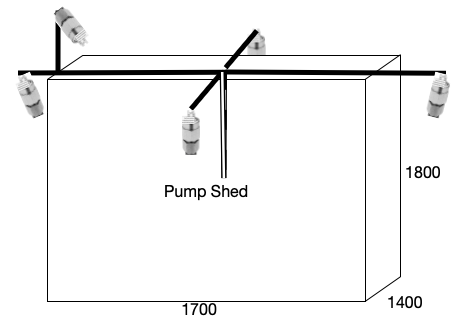 |  |
Shed cooling works even when the main pump is not running, because it is gravity-fed from the elevated tank through 12 mm copper pipe; this keeps the electronics protected throughout a fire. In Autonomous mode AR3 runs it as a thermostat: cooling pulses from 47 °C inside the shed (after it has cooled below 45 °C), continuous if pulses come less than two minutes apart, and continuous at once above 60 °C. In manual mode it is set with the Time ON2 and Time OFF2 controls on the dashboard (see Output Control and Safety Interlocks).
Ventilation. The diesel engine needs a good supply of air, and some heat must be carried away, but vents would let hot air in once the outside temperature rises above that of the cooled shed. The current set-up therefore relies on air entering through the gaps in the shed's construction, together with the cooling spray. The pump exhaust leaves through a 2-inch stainless steel pipe through the shed wall, coupled to the pump's exhaust port by a 400 mm length of 40 mm high-temperature silicone hose. If it ever proves necessary, a fire damper could be fitted in the wall opposite the pump's air intake. These close automatically at around 100 °C: for example the Lorient LVH44 intumescent fire damper (100 × 100, from ASSA Abloy, $74.09 excluding GST), the Kilargo IFD44-L with sodium silicate slats (from Idealair, about $97 trade), or a curtain damper whose interlocking blades drop when a fusible link breaks. So far, spray cooling alone has kept temperatures under control.
Insulation. Lining the shed with insulation board was considered but not done: the cooling sprays keep the shed's surface temperature down, any insulation would have to be fire-rated, and the diesel pump can operate at quite high ambient temperatures (practical experience suggests well above the maker's stated maximum). If needed, a fire-resistant lining could be added later - Fire Crunch board (glass-fibre-reinforced magnesium chloride, rated to BAL-40 or Flame Zone) would suit. However, insulation would keep the heat of the fire out to some extent, but would also seal in the heat from the diesel pump. As alternative, fire-vulnerable items (circuit boards, the plastic-covered valve motors, the Dosatron) could be wrapped in fire-resistant thermal insulation. At this point we are relying on shed cooling.
Materials in the shed. A decision was needed whether to keep to brass and copper in the pump shed or use cheaper PVC. PVC is rated to only about 50 °C, at which its design pressure rating falls from 2 to 0.4. Automotive wiring is good to about 120 °C and diesel does not self-ignite below about 210 °C, so those are not immediate concerns. The Garpen pump's maximum operating temperature is not clear: 49 °C (120 °F) is cited in the US standard for fire pump rooms, but experience in the field suggests it keeps running at much higher temperatures. The most vulnerable component is the Dosatron gel pump, rated to only 40 °C, hence on-going consideration of lagging it and its fail-safe branch. At the moment a one-way check valve and fail safe solenoid valve ensures that if the dosatron fails the system can continue to operate. Nevertheless, even though the shed sprays are relied on to keep temperatures workable, brass fittings, copper pipe and fire-rated hose were used wherever available.
Last checked: 7 November 2026. Earlier plans and run-time estimates: Development history: the water system.
<< Sprinklers and pipework | | The Gel Injection System >> |Table of Contents>